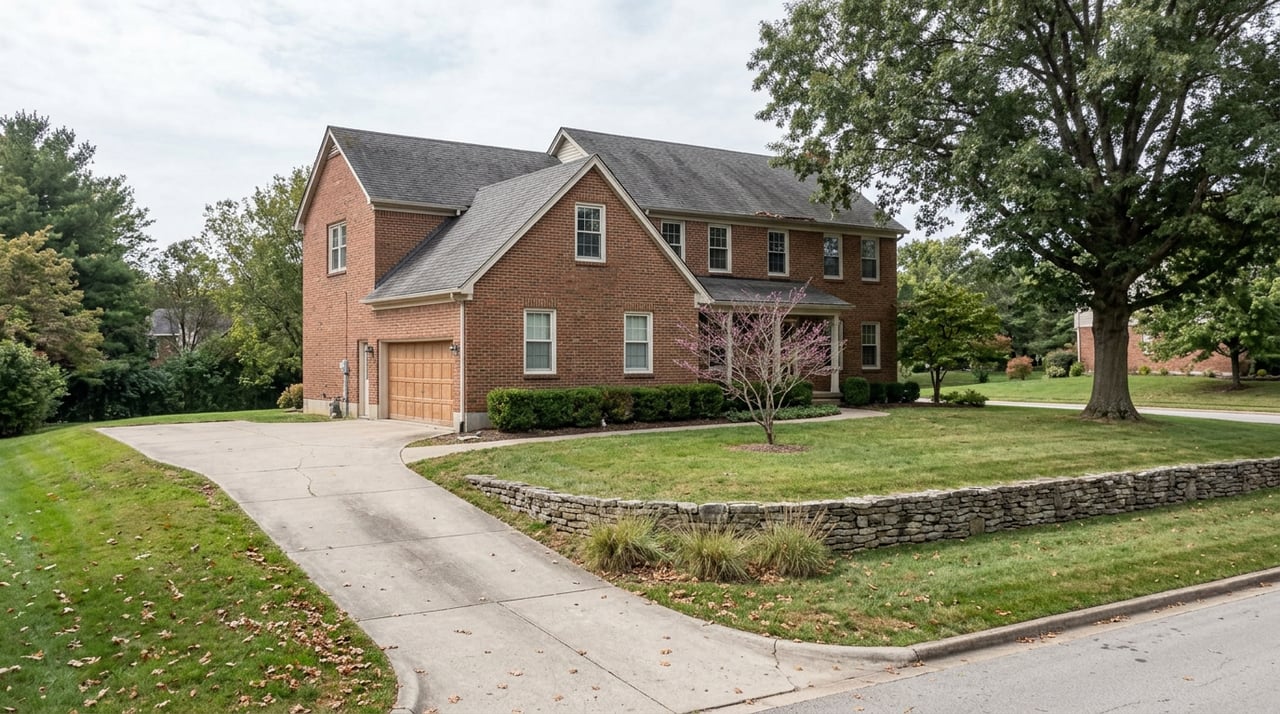
Ask three different listings in Floyds Knobs what utilities come with the house, and you'll get three different answers. One says septic and a private water company. Another says public water and sewer, full stop. A third barely mentions it at all. That's not a data problem. It's the actual shape of this market, and it catches buyers off guard at exactly the wrong moment: inspection week, when there's a deadline attached to figuring out which situation you're actually in.
Floyds Knobs sits on the Knobstone Escarpment a few miles northwest of downtown New Albany, and the terrain that gives the area its hilltop views also explains why utilities never got standardized the way they did in flatter, more built-out suburbs. Some pockets tied into municipal systems decades ago. Others never did, and still run on individual septic paired with a private water utility. New subdivisions have made their own choices more recently, and not all of them chose the same thing. The result is a neighborhood where the utility setup isn't a Floyds Knobs question. It's a subdivision question, and sometimes a street question.
The Subdivision Line Nobody Draws For You
Newer developments in the area have quietly broken from the septic-and-well assumption altogether. Lakeside Forest, for example, is marketed with sidewalks, sewers, a neighborhood pool and a clubhouse, the kind of package that reads more like a planned suburb than a rural hilltop. Côte de Chambord, a smaller enclave, lists natural gas, public water, sewer and electricity as already in place on its remaining lots.
Compare that to the older acreage and established subdivisions that make up much of the rest of the Knobs, where listings routinely note individual septic and water service through the Floyds Knobs Water Company, a private community utility rather than a municipal system. Neither setup is better or worse on its face. But they come with completely different inspection timelines, different costs, and different questions for your lender. A buyer who assumes the whole area works one way will be planning for the wrong process.
What "Septic and Well" Usually Means Here
Here's the part that trips people up even when they know septic is involved: septic and well aren't automatically a pair. Most Floyds Knobs properties on individual septic get their water from the Floyds Knobs Water Company, not from a private well on the property. A true private well, the kind you'd need to test and maintain yourself, is a smaller subset of homes in the area, usually the more rural or larger-acreage parcels.
That distinction matters because it changes who's responsible for what. Before you assume you're buying into either the septic-only side of the ledger or the septic-and-well side, ask which one the specific property actually has. It's a one-sentence question to the listing agent, and it changes your entire due diligence checklist.
The Inspection Indiana Doesn't Require, Until Your Lender Does
According to SepticSeeker, Indiana has no statewide law forcing a septic inspection before a home with an existing system changes hands.
In practice, most mortgage lenders require a satisfactory septic inspection as a condition of loan approval, particularly for FHA and VA financing. So the state stays out of it, and the lender steps in instead. The inspection itself is almost always a dye test: a technician flushes dye through the system and watches the yard to see whether it surfaces where the drain field is failing to absorb waste the way it should. It's quick, it's not invasive, and it's the standard buyers should expect during their inspection period regardless of what the purchase contract says about it.
If the property involves new construction or a septic system that's being repaired or replaced, that's a different and more involved process. The Floyd County Health Department's sanitarian inspects during installation. That level of oversight applies to construction, not to a routine resale inspection on an existing system.
What Shows Up on the Invoice
Costs vary by property, but the ranges are consistent enough to plan around.
| Item | Typical Cost Range | When It Comes Up |
|---|---|---|
| Septic dye test / inspection | A few hundred dollars | During the buyer's inspection period |
| Tank pumping | Similar to inspection cost | Almost always requested after inspection |
| Riser installation | Modest, one-time cost | If the tank lid isn't already at ground level |
| Water test (if on a private well) | Modest | When the appraiser or lender flags it |
| Full septic system replacement | Can reach the tens of thousands | Rare, but the worst-case outcome, driven by soil conditions, system size and site access |
None of these numbers are Floyds Knobs-specific rules. They're what typically shows up once an inspector or lender is involved, and they're worth knowing before you're staring at a report with a response deadline.
The Two Requests That Show Up After Almost Every Dye Test
If a septic inspection turns up anything at all, it's usually one of two things. First, the buyer asks for the tank to be pumped, which is routine maintenance rather than evidence of a problem. Second, if the tank doesn't already have a riser, the buyer asks for one to be installed so the lid sits at ground level instead of buried under a foot of soil. That makes future servicing dramatically easier and is a common ask even on systems that are otherwise in good shape.
Neither request is a deal-breaker, and neither one should derail a negotiation if you see it coming. The sellers who handle this smoothly are the ones who know their system's condition before they list, rather than finding out for the first time when a buyer's inspector hands over the report.
If You're the One on the Well
For the smaller share of Floyds Knobs properties on an actual private well, the rules shift again. Private well water in Indiana is unregulated by both the Indiana Department of Environmental Management and the Environmental Protection Agency The Indiana Department of Health recommends annual testing at minimum, in part because many common well water problems have no color, taste or odor that would tip off the people drinking it.
Testing is straightforward to arrange. The Indiana State Department of Health Laboratories provide test kits for bacteriology, nitrates and nitrites, fluoride, and lead, copper and arsenic, and private certified labs around the state offer the same services. If you're buying a well property, ask for the most recent test results and compare them to any prior records. If you're selling one, running a fresh test before you list removes one more unknown from the negotiation.
Disclosure Forms and Utility Systems
Regardless of which utility setup a property has, Indiana sellers have disclosure obligations.
The Through-Line
The septic-and-well reputation that follows Floyds Knobs around isn't wrong, but it's not the whole story either. Some of the newest development in the area has already moved to full public water and sewer, while a lot of the established housing stock still runs on individual systems paired with a private water utility rather than a well. The honest answer to "what utilities does this house have" is specific to the property, not the zip code, and it's worth getting that answer in writing before you're deep into an inspection period with a clock running.
If you're comparing properties across Floyds Knobs and want a straight read on what a specific address is actually running on, before it becomes a contingency deadline, that's the kind of groundwork worth doing early. You can start by browsing current Floyds Knobs listings or get in touch directly through Weston Faulkner to talk through what a particular subdivision or parcel actually involves.
A Few Quick Questions
Does every home in Floyds Knobs have a septic system? No. Older acreage and many established subdivisions do, but newer developments like Lakeside Forest and Côte de Chambord were built with full public water and sewer instead.
If a home has septic, does it also have a private well? Not necessarily. Most septic-served homes in the area get their water from the Floyds Knobs Water Company, a private community utility. A true private well is a smaller subset, usually on larger or more rural parcels.
Does Indiana require a septic inspection before a home sale? Indiana has no statewide requirement, Most lenders require a satisfactory inspection anyway as a condition of financing, so in practice it happens on nearly every financed sale.
Ready to talk through a specific property? Get Your Free Home Valuation or reach out directly to walk through what a Floyds Knobs address is actually running on before you write an offer.
This article is general information, not legal, tax or financial advice. Consult a qualified professional about your situation.